

New Monroe Effect and the Donroe Doctrine: Venezuela in the Hemispheric Geopolitical Reconfiguration

Venezuela has been experiencing one of the most complex crises in its contemporary history for more than a decade, characterized by profound institutional deterioration, a prolonged economic recession, and large-scale social fragmentation. In this context, the country has also become a central focus of regional and international geopolitical debate, particularly due to renewed interest by the United States in Latin America and the reemergence of strategic approaches that some analysts have termed the New Monroe Effect, closely linked to the reinterpretation promoted by Donald Trump known as the Donroe Doctrine.
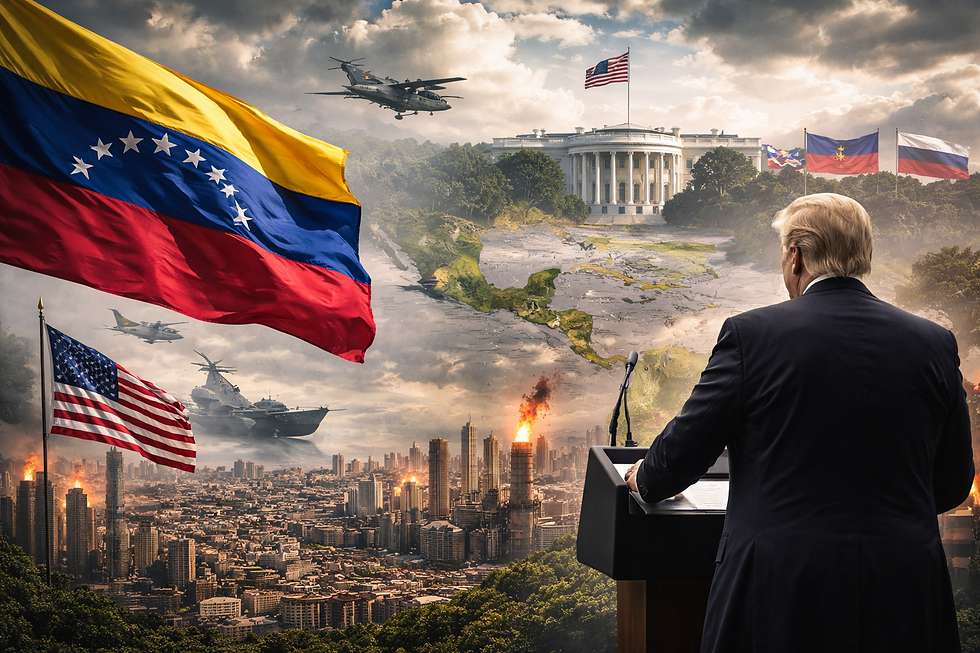
The so-called New Monroe Effect refers to an update of the historic Monroe Doctrine of 1823, through which the United States proclaimed its opposition to the intervention of foreign powers in the American continent. However, in its contemporary version particularly during the administration of Donald Trump this doctrine acquired a more explicit, unilateral, and confrontational character. The so-called Donroe Doctrine, a term that fuses Trump’s surname with the original doctrine, falls within the “America First” approach and asserts that Latin America must remain firmly within Washington’s strategic sphere of influence, without ambiguity regarding the presence of extra-hemispheric actors.
Unlike earlier, more diplomatic or multilateral formulations, the Donroe Doctrine manifests itself through economic sanctions, direct political pressure, national security rhetoric, and explicit warnings against the influence of powers such as China, Russia, and Iran in the region. Venezuela occupies a central place within this logic due to its vast energy reserves, its strategic geographic position, and its strong alliances with these actors, making it an emblematic case of the new U.S. approach.
From an internal perspective, Venezuela continues to face severe structural challenges. The economy has undergone a prolonged contraction, marked by episodes of hyperinflation in recent years, the loss of purchasing power, a decline in oil production, and severe limitations within the financial system. These difficulties are compounded by social problems such as the mass migration of millions of citizens, the deterioration of public services, and a persistent climate of institutional distrust. Although reforms and political dialogue processes have been attempted, the possibility of sustained recovery remains uncertain and conditioned by both internal and external factors.
At the international level, the Venezuelan situation has been interpreted by sectors of U.S. leadership especially during the Trump era as an example of regional instability that justifies a tougher strategic response. Under the logic of the Donroe Doctrine, Washington reinforced the idea that Latin America should not become a space of geopolitical competition for global rivals of the United States. This approach revitalizes a vision of the hemisphere as an exclusive sphere of influence, redefining the Monroe Doctrine in terms of power, deterrence, and global rivalry.
This approach has generated intense debate. Its supporters argue that a firmer U.S. policy may contribute to regional stability, the strengthening of democracy, and the protection of shared strategic interests. Its critics, by contrast, warn of the risk of renewed interventionism, the weakening of the principle of national sovereignty, and the consolidation of a bloc-based logic that limits the autonomy of Latin American countries. In this sense, the Donroe Doctrine reactivates historical tensions between self-determination, hegemony, and hemispheric security.
The New Monroe Effect is not limited to Venezuela, but the country serves as a paradigmatic case of its potential consequences. At the regional level, this vision may lead to a reconfiguration of alliances, increased diplomatic and economic pressure, and a growing centrality of Latin America within global strategic competition. For Venezuela, the challenge lies in navigating this complex environment while seeking internal solutions that enable institutional, economic, and social reconstruction, without becoming merely an object of dispute between major powers.
In conclusion, Venezuela stands at the intersection of a profound internal crisis and a transformation of the hemispheric geopolitical landscape. The so-called New Monroe Effect, reinforced by the Donroe Doctrine promoted by Donald Trump, symbolizes a shift in the way the United States conceives its relationship with Latin America. This shift raises fundamental questions about the future of sovereignty, stability, and regional development. Understanding this phenomenon is essential for interpreting not only Venezuela’s present, but also the dynamics that will define the balance of power in the continent in the years to come.


Comments